
NaMo Drone Didi Scheme, launched by Government of India, is a transformative initiative aimed at empowering rural women and modernizing agriculture through drone technology. By equipping women-led Self-Help Groups (SHGs) with drones and specialized training, the scheme fosters economic independence, enhances agricultural productivity, and bridges the gender gap in rural India.
Namo Drone Didi is not an open “apply online and collect a drone” yojana. It is a central sector scheme that puts a type-certified spray package in the hands of selected DAY-NRLM women Self-Help Groups, finances most of the invoice, trains one member to a DGCA Remote Pilot Certificate, and expects that group to sell spraying as a village service.
From an insurance desk, that last point is the whole file. The machine flies low over other farmers’ crops with a tank of nutrient or pesticide. Year-one comprehensive cover is usually inside the supply package. Year two is when many SHGs discover that an AMC does not replace third-party liability, and that Digital Sky still wants a live policy on the UIN.
This post is written for SHG office-bearers, Cluster Level Federations and the people who will actually sign the AIF loan and the insurance proposal.
What the Namo Drone Didi Scheme is — and what it is not?

On 15 August 2023 the Prime Minister announced Namo Drone Didi as a route for rural women to earn more than ₹1 lakh a year by running agricultural drones. The government then approved it as a Central Sector Scheme of the Department of Agriculture & Farmers Welfare, in convergence with DAY-NRLM. The usual working period in the guidelines is 2024–25 and 2025–26, against an outlay of ₹1,261 crore, with a target of about 15,000 drone packages for women SHGs (some official notes use 14,500 after early machines already placed by fertiliser companies).
On 11 March 2024, at the Sashakt Nari–Viksit Bharat programme, the Prime Minister handed over 1,000 drones to Drone Didis across multiple locations. That event is a real milestone. It is not proof that the 15,000 target is already met.
What the scheme is not:
- A walk-in application on a staging website
- A free drone — the Centre pays 80% of the package, capped at ₹8 lakh
- A mapping hobby programme — the notified business is rental spraying of liquid fertiliser and pesticide
- A guarantee of ₹1 lakh — that is an income target, not a stipend
Official portal: namodronedidi.da.gov.in
The package you are actually buying
CFA is calculated on a drone package, not a bare airframe. Typical contents:
- Type-certified agricultural drone with spray assembly
- Carrying box, standard batteries, four spare battery sets
- Spare propeller set and nozzle set
- Dual-channel fast charger and charger hub
- Downward-facing camera, anemometer, pH meter
- 15-day training for the pilot and training for the drone assistant
- One year comprehensive insurance
- Two-year annual maintenance contract
- Applicable GST and one-year onsite warranty on listed items
Insurance is dated. Comprehensive cover in the package is generally twelve months from supply. Third-party liability under the Drone Rules does not expire with the vendor’s bundle.
AMC is not insurance. It will not pay a crash, a theft from the pickup, or a neighbour’s crop claim after drift.
Money: 80% is not the same as “almost free”
| Item | Working figure |
|---|---|
| Central assistance | 80% of package cost, maximum ₹8 lakh |
| SHG / CLF contribution | Balance of actual package cost |
| Typical funding of the balance | AIF loan, 3% interest subvention (or other MoRD / CLF corpus) |
| Training fee | Included in the package |
| Year-1 comprehensive insurance | Included in the package |
| Year-2 insurance, extra batteries, chemical, transport | Operating cost of the SHG |
If the invoice is ₹10 lakh, CFA is ₹8 lakh and ₹2 lakh must be funded. If the invoice is ₹8 lakh, CFA is ₹6.4 lakh (80%), not the full cap. The residual 20% is why hull cover after year one is not a luxury: the group still owes the loan if the machine is written off.
Who is selected — the official path
- The State Level Committee identifies clusters where hire-out spraying can pay.
- It identifies Cluster Level Federations in those clusters.
- It picks progressive women SHGs from those CLFs.
- DAY-NRLM finalises the list and the Implementation and Monitoring Committee approves it.
- Lead Fertilizer Companies upload the approved list on the drone portal.
Pilot (Drone Didi after the RPC): female SHG member, 18–50, at least Class 10, fit, willing to train at a DGCA-approved RPTO.
Drone assistant: another SHG member or a family member (son, husband, daughter) with a mechanical bent; also 18–50 and Class 10; five-day training.
Do not treat “household income already ₹1 lakh” as the entry test. The guidelines impose an operating commitment: clusters are chosen so a unit can handle on the order of 2,000–2,500 acres a year. That is how the income target is supposed to be hit.
Training that produces a legal pilot
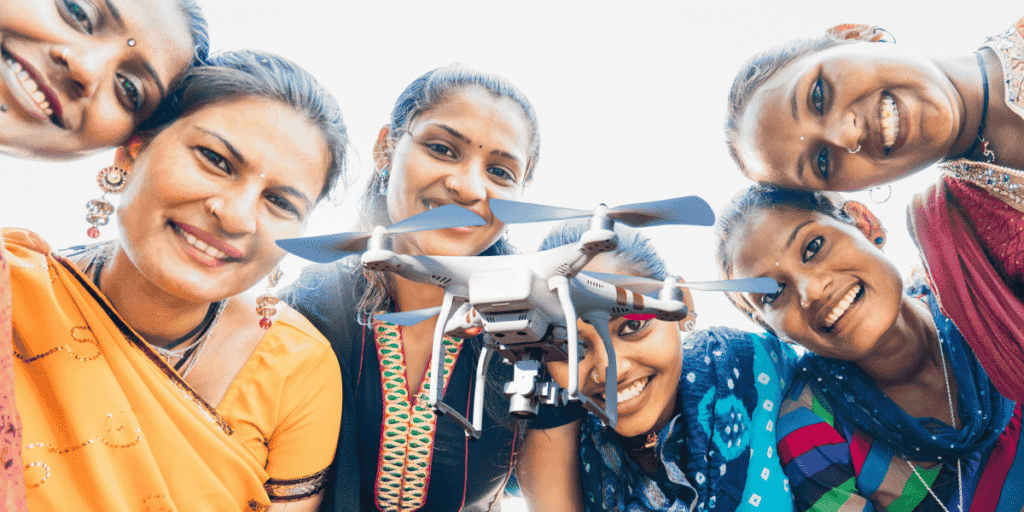
Medium-class: 15 days (about 5 pilot + 10 agri application). Small-class official split: 7 + 8. Assistant: 5 days.
The licence that matters is the Remote Pilot Certificate. Insurers will ask for the RPC of the person at the controls. Spraying also sits under the Ministry of Agriculture SOP and CIB&RC approvals for the formulation. An unapproved mix in the tank is a drift-claim off-ramp.
The insurance file the unit should keep
Year one. Confirm insurer name, UIN on the schedule, hull sum insured, third-party limit, chemical / contamination wording, deductible, and expiry date.
Every year after that. Renew third-party liability before expiry. The Drone Rules, 2021 require TPL for every unmanned aircraft except nano class. A Kisan sprayer is not nano.
One sentence for the broker: “If spray drifts onto the next field, does this policy pay?” If the answer is a pollution exclusion, do not fly hire-out work on that wording.
Declare loaded MAUW. Insure the machine at full-tank weight.
Indicative renewal for a single type-certified sprayer with hull, payload and chemical-aware TPL often sits in the ₹20,000–₹60,000 a year band. Price it into the 2,000-acre plan.
Crop insurance (AIC / PMFBY) assesses the farmer’s field. The SHG’s airframe is a general-insurer UAS product. Do not conflate the two.
What is verified — and what is not repeated here?
Verified: announcement date, 11 March 2024 handover of 1,000 machines, ₹1,261 crore, ~15,000 packages, 80% / ₹8 lakh, AIF 3%, selection path, package including insurance and AMC, pilot/assistant rules, official portal.
Not repeated as fact: national “10–15% yield” or “30% less chemical” results, invented SHG P&Ls, a live drone count for September 2026.
For current lists, use the downloads and MIS on the official portal. Whether a given state still has headroom after the 2025–26 window is an SLC question, not a blog guess.
Checklist if the SHG is already on the list
- Confirm the name is on the approved portal list.
- Read the invoice against the guideline package — batteries, training, insurance period, AMC period.
- Keep UIN, RPC and policy expiry in one file.
- Diary renewal 45 days before year-one cover ends.
- Keep a flight and weather log.
- Price the acre to fund batteries, compliance and renewal, not only the AIF EMI.
- Do not let an unlicensed relative fly “because she watched the training.”
FAQs On Namo Drone Didi Scheme
Q.1: What is the Namo Drone Didi Scheme, in one paragraph?
Ans: It is a Central Sector Scheme of the Department of Agriculture & Farmers Welfare, run with DAY-NRLM, that gives selected women SHGs a type-certified spray-drone package, pays 80% of that package up to ₹8 lakh, folds in RPTO training, year-one comprehensive insurance and a two-year AMC, and expects the group to earn extra income by hiring the machine out to farmers for liquid fertiliser and pesticide work. It is a livelihood-plus-mechanisation scheme, not a free-gadget scheme.
Q.2: Who announced it, and when did machines actually move?
Ans: The Prime Minister announced it on 15 August 2023. Guidelines and approval followed that year; the working period in the guidelines is 2024–25 and 2025–26. The public handover people remember is 11 March 2024, when 1,000 drones were given to Drone Didis at the Sashakt Nari–Viksit Bharat programme. Announcement, approval and physical delivery are three different dates.
Q.3: Is Namo Drone Didi still open in September 2026?
Ans: The approved window runs through 2025–26. Some states still have residual training, AIF paperwork or delayed supply. That is not a fresh national window. Check namodronedidi.da.gov.in, the State Rural Livelihood Mission and the SLC — not a third-party “apply now” page.
Q.4: Can any woman apply on the website?
Ans: No. The unit of selection is a DAY-NRLM registered women SHG inside a cluster the State Level Committee has already identified. Path: cluster → CLF → progressive SHG → DAY-NRLM list → IMC → LFC upload on the portal.
Q.5: What does “economically feasible cluster” mean?
Ans: A patch where a sprayer can stay busy enough to service the loan — contiguous cropped area, high fertiliser and pesticide use, existing CHCs or large FPOs, enough irrigated acreage. Guidelines talk about 2,000–2,500 acres a year.
Q.6: Who can become the Drone Didi (the pilot)?
Ans: A woman member of the selected SHG, 18 to 50, at least Class 10, fit, willing to train at a DGCA-approved RPTO. After the Remote Pilot Certificate she is called a Drone Didi.
Q.7: Who can be the drone assistant? Does it have to be another woman in the SHG?
Ans: No. Another SHG member or a family member (son, husband or daughter) with a mechanical bent. Same age band and Class 10. The five-day assistant course does not authorise that person to fly.
Q.8: Must the pilot already earn ₹1 lakh a year to qualify?
Ans: No. That figure is the income target from hire-out spraying, inside the wider Lakhpati Didi goal — not an entry gate.
Q.9: Are the drones free?
Ans: No. CFA is 80% of package cost, capped at ₹8 lakh. On a ₹10 lakh invoice the Centre pays ₹8 lakh; on an ₹8 lakh invoice it pays ₹6.4 lakh. The rest is usually an AIF loan at 3% interest subvention.
Q.10: What exactly is inside the “drone package”?
Ans: Type-certified sprayer and tank, carrying box, standard batteries plus four spare battery sets, spare props and nozzles, chargers, camera, anemometer, pH meter, pilot and assistant training, one year comprehensive insurance, two-year AMC, GST and a one-year onsite warranty. Count the spare batteries and the insurance end-date on the invoice.
Q.11: What training is compulsory, and how long is it?
Ans: The selected woman must hold an RPC. Medium-class: 15 days (about 5 pilot + 10 agri). Small-class official split: 7 + 8. Assistant: 5 days. A handover photograph is not a licence.
Q.12: Can the SHG use the drone only on its own members’ fields?
Ans: The scheme is written as a rental service to farmers in the cluster. Own-farm use alone will not service an AIF loan.
Q.13: Do we need DGCA registration and a UIN?
Ans: Yes. The insurance schedule should name the UIN. After a loss, serials, flight-control module and UIN must match the policy.
Q.14: Does the scheme include insurance?
Ans: Yes — for the first year. Confirm insurer, UIN, hull sum, TPL limit, chemical/drift wording, deductible and expiry date. It is not a lifetime policy.
Q.15: Is drone insurance mandatory after that first year?
Ans: Third-party liability is mandatory above nano class. A Kisan sprayer is not nano. Hull is not compelled by the Rules, but if an AIF loan is outstanding, a write-off without hull leaves the SHG paying for a machine that no longer exists. Indicative renewal for one type-certified sprayer with chemical-aware TPL: often ₹20,000–₹60,000 a year.
Q.16: If spray drifts onto the next field, will insurance pay?
Ans: Only if the wording says so. Ask in writing: “If spray drifts onto a neighbour’s crop, does this policy pay?” A pollution exclusion is the farm risk wearing a different name.
Q.17: Is the two-year AMC enough protection?
Ans: No. AMC is defects and servicing. It does not pay crash, theft, fly-away or third-party injury.
Q.18: Is AIC / PMFBY the same as drone insurance?
Ans: No. Crop insurance covers the farmer’s crop. The SHG’s airframe and neighbour liability are a general-insurer UAS product.
Q.19: What documents will an insurer or the portal ask for?
Ans: NRLM / SHG papers, pilot KYC, group bank account, invoice and serials, UIN, RPC, loaded MAUW, spray use-case. After a loss: photos, flight and weather log, FIR for theft, Digital Sky record if required.
Q.20: Can we insure or subsidise a non-type-certified kit?
Ans: Not under this scheme, and often not on decent wording.
Q.21: Who books work and who keeps the money?
Ans: A CLF / SHG decision. Decide in writing who books, who collects, who pays for batteries and chemical, and who holds the policy file.
Q.22: Who should the SHG call first?
Ans: The CLF, the SLC / State Nodal Officer on the official portal, and the LFC coordinator. For the licence: the allotted RPTO. For renewal: an IRDAI-approved UAS insurer who will put the UIN and spray use on the schedule.
Q.23: Can the drone fly at night, BVLOS, or in a red zone?
Ans: Not on the standard scheme profile. Default is VLOS, daytime, 1.5–3 metres above canopy, in permitted airspace. Anything else needs permission and usually a policy endorsement.
Namo Drone Didi gives an SHG a subsidised, trained, type-certified sprayer and a year of comprehensive cover. After that, the group is a small aviation business. The RPC, the UIN, the chemical SOP and a live third-party policy are what separate a Drone Didi from an uninsured crash and a neighbour’s claim.
To read this post in hindi click – नमो ड्रोन दीदी योजना — महिला सशक्तिकरण और आधुनिक कृषि की दिशा में ऐतिहासिक कदम