
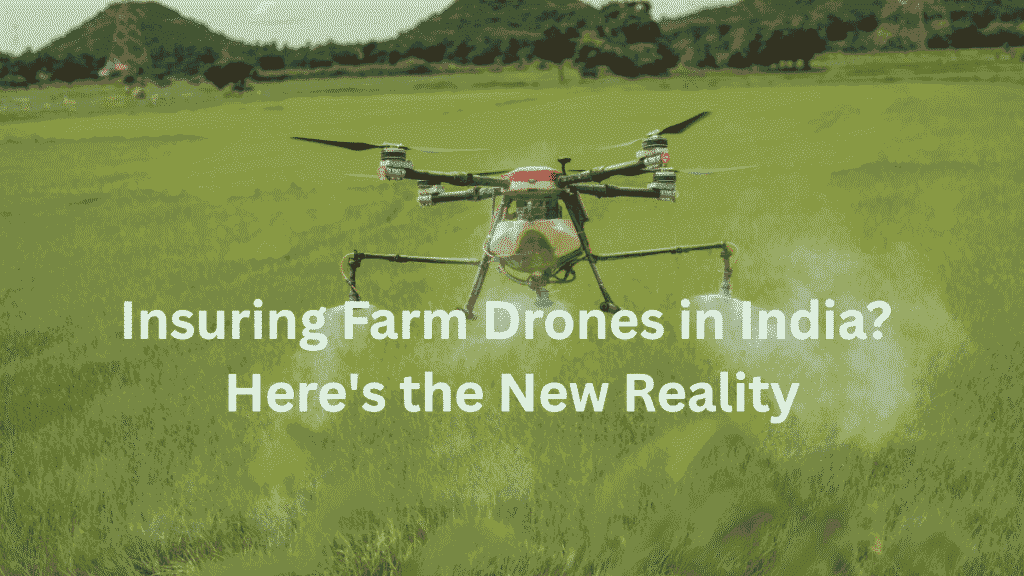
Most operators buy a drone first and discover Agricultural Drone Insurance in India only when Digital Sky, a lender, or a neighbour’s crop claim forces the issue. The right policy is not a generic “drone pack”; it is third-party liability that actually contemplates chemical drift, plus hull written on the loaded weight and the UIN.
A spraying drone sitting in a Custom Hiring Centre in Guntur or a Namo Drone Didi unit in Sitapur is not a gadget. It is a ₹4–8 lakh capital asset that flies low over other people’s crops while carrying a tank of pesticide. That combination — expensive hardware, chemical payload, public airspace — is why insurance for agricultural drones in India is both a legal requirement and a business control, not a nice-to-have add-on.
This post is written for three readers who are usually lumped together and should not be: the individual farmer who owns one machine, the FPO or CHC that hires it out and the women SHG operating under Namo Drone Didi. The risk, the subsidy paperwork, and the policy wording are not the same for all three.
What changed in Indian farm aviation — and what did not?

The policy push is real. In the Union Budget 2022–23 the Centre said it would promote “Kisan Drones” for crop assessment, land-record work, and spraying of insecticides and nutrients. On 19 February 2022 the Prime Minister flagged off 100 such machines. Under the Sub-Mission on Agricultural Mechanization (SMAM), ICAR institutes, KVKs and state agricultural universities have since run tens of thousands of field demonstrations. Namo Drone Didi, approved as a central sector scheme with an outlay of ₹1,261 crore for 2023–24 to 2025–26, is designed to put about 15,000 spray packages in the hands of women SHGs.
The machines themselves are mostly rotary-wing sprayers in the small (2–25 kg) and, increasingly, medium (25–150 kg) DGCA weight classes: 10-litre and 16-litre tanks, terrain-following, four or more nozzles, type-certified airframes from Indian and imported lines. Mapping and multispectral work exists, but the commercial centre of gravity in 2026 is still hire-out spraying.
What has not changed is the physics of the risk. A loaded sprayer is heavier than the empty weight printed on the brochure. Wind above the SOP envelope turns a precise swath into drift. A battery swell or GNSS glitch at 2 metres above canopy is a hull claim; the same event over a neighbour’s organic plot or a village pond is a liability claim. Insurance has to be bought with that distinction in mind.
Market-size figures vary by research house — typically from about USD 145 million in 2024 toward the USD 600–730 million range by 2030–31, at a mid-20s CAGR. Treat any single “₹121 million by 2030” headline as a unit error. The direction of travel is not in doubt; the exact rupee print is.
The law: third-party cover is mandatory. Hull is not (but you still need it)
Under the Drone Rules, 2021 (notified 25 August 2021, later amended), an unmanned aircraft other than nano class (≤250 g) may not be operated in India unless a valid third-party insurance policy is in force. The rule applies the Motor Vehicles Act, 1988 mutatis mutandis to compensation for death, bodily injury and property damage. In the original gazette this sits at Rule 44; later official compilations number the same obligation as Rule 66. The substance is identical.
Practical consequences:
- Almost every agricultural spray drone in commercial use is well above 250 g. Nano exemption is irrelevant to Kisan drones.
- The product must be an IRDAI-approved UAS / drone wording, not a homemade “equipment all-risk” endorsement that does not name the UIN.
- Digital Sky / eGCA workflows expect the policy to travel with the aircraft. Operating without valid third-party cover is a scheduled contravention (penalty in the rules: ₹10,000), quite apart from any civil claim.
- Hull (physical damage) cover is not what Rule 44/66 mandates. It is what lenders, subsidy packages, and your own balance sheet require. A CHC that loses a ₹6 lakh type-certified sprayer mid-season without hull cover has a business-interruption problem, not merely a repair bill.
Remote Pilot Certificate (RPC) from a DGCA-approved RPTO, UIN on Digital Sky, type certification for the airframe, and — for pesticide work — compliance with the Ministry of Agriculture & Farmers Welfare SOP and CIB&RC approvals for the formulation, sit alongside insurance. An insurer can decline or void a claim if the flight was illegal. Insurance does not legalise an uncertified spray mix or an unlicensed pilot.
How government schemes already touch the insurance file?
SMAM / Kisan drone assistance (current central slabs; states administer and may add conditions):
| Beneficiary | Assistance | Ceiling per drone |
|---|---|---|
| ICAR institutes, FMTTIs, KVKs, SAUs and eligible government institutions — for demonstration | Up to 100% | ₹10 lakh |
| FPOs — for demonstration on farmers’ fields | Up to 75% | As notified (applied to actual cost, subject to scheme cap) |
| Agriculture graduates setting up a CHC | 50% | ₹5 lakh |
| Small & marginal farmers, SC/ST, women, North-Eastern state farmers — individual ownership | 50% | ₹5 lakh |
| Other individual farmers | 40% | ₹4 lakh |
| CHCs under farmer cooperatives / FPOs / rural entrepreneurs | 40% | ₹4 lakh |
| Contingency for agencies hiring machines for demonstration | ₹6,000 / hectare | — |
Subsidy is normally available only on DGCA type-certified machines. Uncertified kits are cheaper on the invoice and harder to insure, service, or resell.
Namo Drone Didi is a different stack. Selected DAY-NRLM women SHGs receive central assistance of 80% of the drone package, capped at ₹8 lakh. The remaining 20% can be borrowed under the Agriculture Infrastructure Fund at a 3% interest subvention. The notified package is not a bare airframe: it typically includes spray assembly, spare batteries, charger, 15-day pilot training, assistant training, a two-year AMC — and one year of comprehensive insurance.
That last line matters. A Drone Didi unit is often insured for year one inside the package. Year two is when operators discover that comprehensive cover was time-bound, the AMC does not replace third-party liability, and the UIN still needs a live TPL certificate. Budget the renewal before the first monsoon cycle ends.
The covers that matter on an Indian farm — and the ones that usually do not
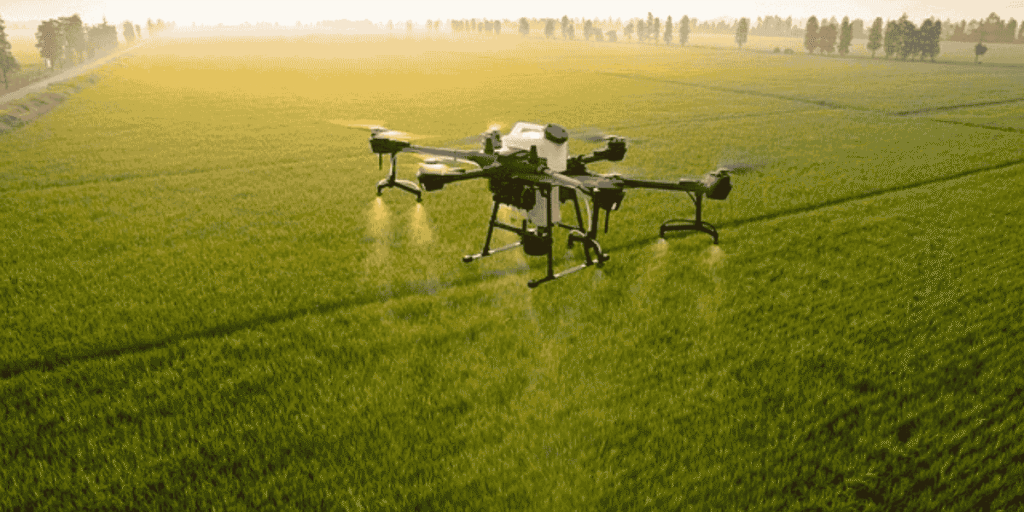
1. Third-party liability (the statutory layer)
Pays compensatory damages if the drone, or something falling from it, causes death, injury or property damage to someone who is not your employee. This is the Rule 44/66 cover.
For a single small sprayer working village fields, operators commonly buy ₹10 lakh to ₹50 lakh any-one-accident limits. Service businesses flying every day across multiple villages, or anyone spraying near habitations, pack-houses or water bodies, should be looking at ₹50 lakh to ₹1 crore.
Read the chemical / pollution exclusion. Standard aviation-style TPL often covers “property damage” but carves out gradual pollution, contamination, and sometimes the very drift event you bought the policy for. Agricultural operators need the exclusion deleted, a chemical-liability endorsement, or a wording that expressly contemplates pesticide application. If the proposal form never asked what you spray, the policy was not underwritten for your work.
2. Hull (the asset layer)
Crash, fly-away, fire, theft, transit, water ingress, weather. Sum insured should be replacement value of the type-certified configuration you actually fly, not the empty-weight showroom price.
Two underwriting traps:
- Declared MAUW versus operational MAUW. A 16-litre sprayer that is 28 kg empty and ~40–45 kg loaded must be declared and insured at the loaded figure. Mismatch is a classic claim-repudiation ground.
- Batteries and spare airframes. Swappable batteries are a large share of replacement cost and are not always automatically included. Say so on the schedule.
Indicative hull rates for ordinary commercial drones in India often sit around 1.5–2.5% of insured value per year. Spray work, higher MAUW, and poor claims history push that up. A blanket “10% of drone value” is a stale rule of thumb, not a 2026 market quote.
3. Payload and spray system
Tanks, pumps, nozzles, flow meters, and any camera or multispectral rig. Insure the wet system as payload or as a scheduled component — not as an afterthought.
4. Pilot personal accident
A fall from a pickup while mounting a tank, or injury during a hard landing, is more common than a cinematic mid-air event. Modest PA limits (₹10–25 lakh) are inexpensive next to the hull.
5. What most smallholders can skip
Cyber liability is for data businesses, not a one-machine farmer. Errors & omissions is for consultants selling maps as a professional service. Non-owned cover does matter if you rent machines. Workers’ compensation is an ESIC / state WC question if you have employees — it is not a substitute for TPL.
What it actually costs in 2026?
Quotes move with UIN history, pilot hours, geography and limit. These are working bands, not tariffs:
| Setup | What you are buying | Indicative annual premium |
|---|---|---|
| Mapping / scouting micro or light small drone | TPL only | ₹3,000–₹8,000 |
| Small commercial survey drone | TPL + hull + payload | ₹15,000–₹40,000 |
| Single agricultural sprayer (farmer or small CHC) | TPL + hull + payload, chemical endorsement | ₹20,000–₹60,000 |
| Multi-machine CHC / SHG fleet | Fleet schedule, higher TPL, transit | ₹40,000–₹1,50,000+ |
| BVLOS or corridor work | Endorsement on top of the above | Often +50–100% on the relevant section |
A ₹5 lakh sprayer does not automatically cost ₹50,000 a year to insure. If a broker quotes 10% without seeing the UIN, RPC and spray SOP, get a second quote.
Where claims actually come from?
Spray drift. Wind above the envelope in the crop-specific SOP (typically 1.5–3 metres above canopy, speed in the 3–5 m/s band depending on crop and nozzle). Neighbour’s chilli, organic basmati, or aquaculture pond takes the droplet. This is the claim that standard TPL silently excludes if you did not buy the chemical wording.
Hard landing / fly-away. GNSS drop-out, badly configured low-battery failsafe, propeller strike on a field bund, or an operator flying outside VLOS because “the field is long.” Hull claim if declared properly; nothing if the flight was illegal.
Theft from the pickup. Transit and overnight storage are ordinary Indian risks. Say where the machine sleeps.
Wrong machine on the policy. Serial number, flight-control module and UIN must match Digital Sky. After a crash, that is the first thing the surveyor checks.
Unapproved chemical or uncertified airframe. CIB&RC has a limited list of formulations cleared for drone application. Flying an assembled kit that never received type certification, or a pesticide not cleared for UAS, gives the insurer a clean off-ramp.
Illustrative — not invented ₹5 lakh settlements:
- A Punjab wheat sprayer in a 20 km/h crosswind deposits insecticide on an adjacent vegetable plot. If chemical liability is on cover and the log shows wind was within SOP, this is a TPL claim. If the policy is silent on contamination, it may not be.
- A Maharashtra FPO’s type-certified sprayer loses a motor on a mapping pass and writes off the airframe. Hull pays replacement minus deductible if MAUW and UIN match the schedule.
- A Namo package reaches month 13. Comprehensive cover in the supply contract has expired. The SHG still has an AMC for defects, which will not pay a crash or a third-party injury. That is a renewal failure, not a product failure.
How to buy without wasting a season?
- Start from the operation, not the brand of insurer. Own-farm spraying, hire-out CHC, mapping-only, or Drone Didi rental are four different proposals.
- Put the compliance pack on the table: tax invoice, type-certificate, UIN, serials of airframe and flight controller, RPC, intended chemicals, operating geography, loaded MAUW.
- Insist the schedule names the UIN and states spray / agricultural use. A “commercial photography” wording is the wrong product.
- Ask three questions in writing: Is contamination / chemical drift covered or excluded? Are spare batteries and the spray tank included? What is the deductible on hull versus TPL?
- Compare IRDAI-filed wordings, not logos. Products exist from general insurers including Tata AIG, ICICI Lombard, HDFC ERGO, Bajaj Allianz, New India Assurance, Oriental (UAV UDAN) and others. Specialist platforms such as TropoGo sit in front of those carriers. IFFCO Tokio and rural PSU networks matter if your distribution is a district office, not an app.
- Do not treat year-1 Namo / dealer “comprehensive” as perpetual. Diary the expiry. TPL must remain continuous for Digital Sky.
- Keep the flight log and maintenance record. Claims that cannot show a pre-flight check and weather note are the ones that stall.
FAQs On Agricultural Drone Insurance in India
Q.1: Is drone insurance mandatory for farmers in India?
Ans: Third-party liability is mandatory for every drone except nano class. That includes agricultural spraying and commercial mapping. Hull is not what the Drone Rules compel, but running a subsidised or financed sprayer without hull is a capital risk, and some scheme packages and lenders expect it.
Q.2: Does the Kisan / SMAM subsidy pay for insurance?
Ans: The subsidy is for the machine (and specified attachments), not a standing insurance budget — except where a package (notably Namo Drone Didi) explicitly includes one year of comprehensive cover. Renewal is the operator’s cost.
Q.3: Will my policy pay if spray drifts onto the next field?
Ans: Only if the wording covers that event. Ask for the contamination / chemical-liability position in writing before you pay the premium.
Q.4: What documents do insurers ask for?
Ans: Proof of ownership, UIN and serials, RPC of the person who flies, KYC (Aadhaar / PAN), use-case declaration, and loaded specifications. After a loss: FIR for theft, Digital Sky incident record if required, maintenance log, and photographs.
Q.5: Can I insure a non-type-certified kit?
Ans: Some carriers will not. Those that will often charge more, cap the hull, or exclude commercial spray. You also step outside SMAM subsidy conditions.
Q.6: Is Agricultural Insurance Company of India the place to buy drone hull?
Ans: AIC’s core book is crop insurance (PMFBY and related). Drones are used inside crop-insurance assessment; the airframe itself is generally placed with a general insurer that has an IRDAI-filed UAS product. Do not conflate the two.
A short buying rule
If you fly a type-certified sprayer over someone else’s crop, you need continuous third-party cover that actually contemplates chemicals, plus hull and payload written on the loaded MAUW and the UIN. Everything else is optional until your operation grows into it.
The technology is no longer experimental. The insurance file should not be either.